
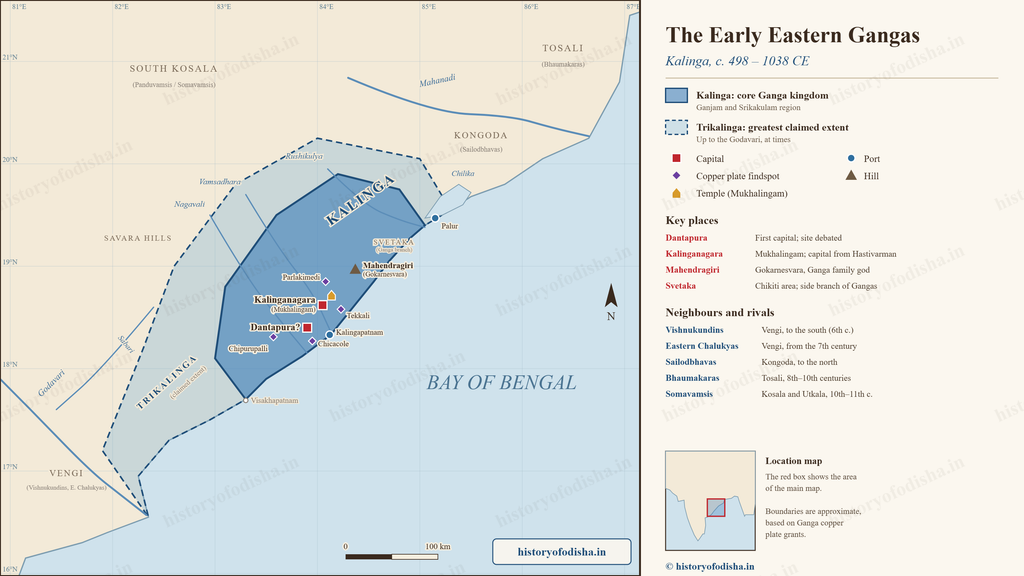
The Gangas of Kalinga are known in history as the Eastern Gangas, to distinguish them from the Gangas of Mysore (Karnataka), who are called the Western Gangas. For about six centuries, from the late 5th century to the early 12th century CE, the early Eastern Gangas ruled a small kingdom in Kalinga, with their capital first at Dantapura and later at Kalinganagara (modern Mukhalingam in Srikakulam district, Andhra Pradesh). In the 11th century their power revived under Vajrahasta V, and his great-grandson Anantavarman Chodagangadeva went on to conquer Utkala and found the Imperial Ganga empire of Odisha.
This article covers the early Eastern Gangas up to Vajrahasta V. Their famous successors are discussed in The Imperial Gangas.
Key points at a glance
| Item | Details |
|---|---|
| Region | Kalinga: south Odisha (Ganjam) and north coastal Andhra (Srikakulam, Vizianagaram) |
| Capitals | Dantapura, then Kalinganagara (Mukhalingam) on the Vamsadhara |
| Legendary founder | Kamarnava, said to have come from Kolahalapura (Kolar) in Gangavadi |
| First historical king | Indravarman I (Jirjingi plates, Ganga year 39) |
| Ganga era | Began about 496–498 CE; used in charters for over 500 years |
| Title | Trikalingadhipati (Lord of the three Kalingas); later Sakala-Kalingadhipati |
| Religion | Saiva (Gokarnesvara on Mahendragiri; Madhukesvara at Mukhalingam); also Vishnu and the Sun |
| Revival | Vajrahasta V (crowned 1038 CE) |
| Successors | Imperial Gangas under Anantavarman Chodagangadeva |
Origin of the Eastern Gangas
According to a tradition preserved in the early copper plate grants of Chodaganga, the Eastern Gangas of Kalinga were a branch of the Western Ganga family of Mysore.
- Kamarnava, the founder of the Eastern Ganga dynasty, is said to have left Kolahalapura (Kolar) in Gangavadi vishaya with his four brothers, leaving his ancestral kingdom to his paternal uncle.
- He came to the Mahendragiri hills, worshipped Gokarnesvara Siva there, and then occupied the Kalinga country after defeating the Savara chief Baladitya.
- How far this tradition is based on history is impossible to say.
The story suggests two things: the dynasty claimed a link with a famous southern royal house, and it won its kingdom in the hill country of south Kalinga, where tribal chiefs such as the Savaras held power. The deity Gokarnesvara of Mahendragiri remained the family god of the Gangas.
Note: the tradition is recorded only in charters of the 11th–12th centuries, some five or six centuries after the events it describes. Many historians treat it as a later attempt to give the dynasty a distinguished ancestry.
Sources
Our knowledge of the early Eastern Gangas comes almost entirely from their copper plate grants, found mainly in Ganjam (Odisha) and Srikakulam and Vizianagaram (Andhra Pradesh). They include the Jirjingi, Narasimhapalli, Parlakimedi, Chicacole (Srikakulam), Tekkali, Dharmalingesvara, Almanda, Chipurupalli and Chidivalasa grants, and the charters of Vajrahasta V. Most are dated in the Ganga era, which makes them very valuable for chronology. Temples at Mukhalingam and inscriptions of neighbouring powers (Vishnukundins, Eastern Chalukyas, Pratiharas, Bhaumakaras, Somavamsis) add further information.
The Ganga Era
- The Eastern Gangas used their own era, the Ganga era (Gangeya samvat), in their official charters for over 500 years.
- Since the Jirjingi grant of Indravarman I is dated in Ganga year 39, which the original article equates with 537 CE, the era began in about 498 CE.
- The original article holds that the era probably marks the accession of Indravarman I, the first great ruler of the dynasty.
Note: scholars have proposed starting dates between about 493 and 498 CE; 496–498 CE is the most widely used range. Some hold that the era began with an earlier king rather than with Indravarman I. The equivalent CE dates in this article (based on 498 CE) are therefore approximate.
The First Group of Eastern Ganga Kings
Indravarman I (Ganga year 39, c. 537 CE)
Indravarman I, whose Jirjingi copper plate grant was issued in Ganga year 39 (c. 537 CE), is the first ruler of the dynasty known from reliable records.
- He was a powerful king who commanded many vassal chiefs, and he made Dantapura his capital.
- He is identified with Adhiraja Indra, who, mounted on his elephant Supratika, defeated the Vishnukundin king Indrabhattaraka, who rode the elephant Kumuda.
- He was called Lord of Trikalinga (Trikalingadhipati).
- He was the first great ruler of the dynasty, and the Ganga era probably dates from his accession in about 498 CE.
Note: the location of Dantapura is debated: it has been placed near Srikakulam (the Dantavaktra fort near Amadalavalasa), near Palur in Ganjam, and at other sites. Read more: Kalinga after the Mahabharata War.
Samantavarman (Ganga year 64, c. 562 CE)
The next king, Samantavarman, issued his grant in year 64 (c. 562 CE) from Saumyavana, described as the abode of the goddess of victory. Like his predecessor, he took the title Trikalingadhipati.
Hastivarman (Ganga year 79, c. 577 CE)
King Hastivarman succeeded Samantavarman some time before year 79 (c. 577 CE).
- He fought many battles and claims to have defeated a strong confederacy of enemies.
- He did not call himself Lord of Trikalinga but Lord of all Kalinga (Sakala-Kalingadhipati). From his time until the accession of Vajrahasta V in 1038 CE, no Ganga ruler called himself Trikalingadhipati.
- He was also known as Rajasimha and Ranabhita.
- He was a devotee of Narayana (Vishnu). His Narasimhapalli charter (year 79) records a grant of six halas of land, four shrines (niveshana) and a free feeding house in honour of Narayana, “the Lord of the seven worlds, who sleeps on the seven oceans and for whose pleasure seven Sama songs are sung”.
- Hastivarman moved the capital from Dantapura to Kalinganagara on the banks of the Vamsadhara.
Note: the earlier version sentence “Also known as Rajasimha alias Ranabhita, Hastivarman was also known as Rajasimha” has been simplified.
Indravarman II (Ganga year 91, c. 589 CE)
Hastivarman was succeeded by his son Indravarman II (also called Rajasimha), who ruled at least until year 91 (c. 589 CE), when his Parlakimedi plates were issued.
Indravarman III (Ganga years 128–154, c. 626–652 CE)
The next king, Indravarman III, came to the throne before year 128 (c. 626 CE). He was the son of Danarnava, about whom little is known.
- He issued his first Chicacole grant in year 128 (c. 626 CE), during a lunar eclipse on the full-moon day of Margasira.
- His second Chicacole grant, of year 138 (c. 636 CE), was made on the festival of Ratha Saptami in the month of Magha, showing that Sun worship was widespread in the Ganga kingdom.
- In this charter he claims to have mastered many sciences and arts.
- His last known record is the Tekkali grant of year 154 (c. 652 CE).
- It was probably under him that the Gangas, with Chalukya help, recovered Kalinga after the death of Sasanka, and the Sailodbhava king Madhavaraja II accepted Ganga overlordship. Read more: The Sailodbhavas.
Devendravarman I (Ganga years 183–195, c. 681–693 CE)
The next known king, Devendravarman I, is first mentioned in year 183 (c. 681 CE). He was the son of Gunarnava, of whom no record survives.
- He was a devoted Saiva and received mantra-diksha (initiation) from Patanga Sivacharya in year 184. Patanga Sivacharya was learned in the Vedas, Vedangas, Itihasa and Puranas.
- He also supported Brahmachari Pilli and his sister Pillika Svamini, both learned in the Vedas and Vedangas.
Anantavarman I (Ganga year 204, c. 702 CE)
Devendravarman I was succeeded by his son Anantavarman I, who was on the throne before year 204 (c. 702 CE), the date of his Dharmalingesvara grant. This grant was issued to celebrate the marriage of a princess of the royal family.
Nandavarman and Devendravarman II (Ganga years 221–254)
Anantavarman I was followed by his two sons, Nandavarman and Devendravarman II, as kings of Kalinga. Nandavarman was on the throne before year 221, and Devendravarman II before year 251. Devendravarman II’s last known date is year 254 (c. 752 CE), after which the family disappears from the records for nearly half a century.
Anantavarman II and Devendravarman III (Ganga years 304–310)
- The next important ruler was Anantavarman II, son of Rajendravarman I. No grant of Rajendravarman I has been found, so he, like Danarnava and Gunarnava (the fathers of Indravarman III and Devendravarman I), remains obscure.
- Anantavarman II issued the Almanda grant in year 304 (c. 802 CE) to celebrate the consecration and opening of a tank during a solar eclipse.
- He was followed, before year 306, by his brother Devendravarman III, another son of Rajendravarman I. In year 310, Devendravarman III gave the village of Niyina, free of all taxes, to a Brahmana poet who was the son of his palace door-keeper.
Note: the earlier version said this king “died in the year 310, when he donated the village”; the record only shows that he was ruling in year 310.
Anantavarman III, Rajendravarman II and Devendravarman IV
- Devendravarman III was succeeded by his son Anantavarman III (records of years 313–314).
- Two of Anantavarman III’s sons, Rajendravarman II (year 342) and Devendravarman IV, ruled after him.
- One of Devendravarman IV’s Chicacole grants is dated year 351 (c. 849 CE), and so is a Chicacole grant of his son Satyavarman.
Later kings of the first group
- Satyavarman, son of Devendravarman IV, claims to have won supremacy over all of Kalinga “by the edge of his sword”.
- He was succeeded by his brother Anantavarman IV, known from his Tekkali grant of year 358 (c. 865 CE), and commonly called Vajrahasta I.
- The next king was Maharaja Bhupendravarman, also called Narasimha. He was followed by two of his sons, Anantavarman V and Devendravarman V.
- Anantavarman V issued the Chipurupalli grant in year 383 (c. 881 CE). In this charter he is given the title Maharajadhiraja and is also called Sri Vajrahastadeva (Vajrahasta II).
- He was succeeded by his brother Devendravarman V before year 397 (c. 895 CE), when the Chidivalasa grant was issued.
Genealogy of the first group
From the records above, the genealogy of the first group of Eastern Ganga kings of Kalinga is as follows (numbers after the names are Ganga-era years of their records):
| No. | King | Relation | Known years (Ganga era) |
|---|---|---|---|
| 1 | Indravarman I | — | 39, 60 |
| 2 | Samantavarman | — | 64 |
| 3 | Hastivarman (Rajasimha, Ranabhita) | — | 79, 80 |
| 4 | Indravarman II (Rajasimha) | son of 3 | 87, 91 |
| 5 | Danarnava | — | — |
| 6 | Indravarman III | son of 5 | 128, 137, 138, 154 |
| 7 | Gunarnava | — | — |
| 8 | Devendravarman I | son of 7 | 183, 184, 192, 195 |
| 9 | Anantavarman I | son of 8 | 204 |
| 10 | Nandavarman | son of 9 | 221 |
| 11 | Devendravarman II | son of 9 | 251, 254 |
| 12 | Rajendravarman I | — | — |
| 13 | Anantavarman II | son of 12 | 304 |
| 14 | Devendravarman III | son of 12 | 306, 308, 310 |
| 15 | Anantavarman III | son of 14 | 313, 314 |
| 16 | Rajendravarman II | son of 15 | 342 |
| 17 | Devendravarman IV | son of 15 | 351 |
| 18 | Satyavarman | son of 17 | 351 |
| 19 | Anantavarman IV (Vajrahasta I) | son of 17 | 358 |
| 20 | Bhupendravarman (Narasimha) | — | — |
| 21 | Anantavarman V (Vajrahasta II) | son of 20 | 383 |
| 22 | Devendravarman V | son of 20 | 397 |
Note: the earlier version’s list had many misprints (for example “Indravarman 1-3960”, “Sartlantavarman”, “Indravarman II (son of No. 5)” for Indravarman III, and “Marasimha” for Narasimha). The table above corrects them. Rajendravarman II is placed as a son of No. 15 (Anantavarman III), as the text says.
The Second Group of Eastern Ganga Kings
The second group of Eastern Ganga kings is described in the charters of Vajrahasta V. Seven copper plate grants of this king have been found, and all give the same genealogy of this group, with the number of years each king ruled:
| No. | King | Relation | Years of rule |
|---|---|---|---|
| 1 | Gunamaharnava | — | — |
| 2 | Vajrahasta III | son of 1 | 44 |
| 3 | Gundama I | son of 2 | 3 |
| 4 | Kamarnava I | son of 2 | 35 |
| 5 | Vinayaditya | son of 2 | 3 |
| 6 | Vajrahasta IV (Aniyankabhima / Anangabhima I) | son of 4 | 35 |
| 7 | Kamarnava II | son of 6 | ½ |
| 8 | Gundama II | son of 6 | 3 |
| 9 | Madhukamarnava | son of 6 | 19 |
| 10 | Vajrahasta V | son of 7 | Crowned in Saka 960 (1038 CE) |
Note: the earlier version’s list had many misprints (“Gunarnaharnava”, “Vajrasta III”, “Gundarna”, “KamarnavaJI … 1I2 year”, “Vajrahasia V”). It also gave Vajrahasta IV as “son of No. 2”; the usual reconstruction makes him the son of Kamarnava I (No. 4). Kamarnava II’s reign of half a year is recorded in the charters.
Kalinga between Great Powers
All these Ganga kings ruled over a small region called Kalinga. It was hemmed in by stronger neighbours, and its fortunes rose and fell:
| Period | Event |
|---|---|
| 7th–8th centuries | Hemmed in by the Eastern Chalukyas in the south and the Sailodbhavas in the north |
| c. 8th century | The Kamarupa king Harshadeva claimed victory over Kalinga |
| Early 9th century | The Pratihara king Nagabhata II claimed the conquest of Kalinga and Andhra |
| Middle of the 9th century | The Eastern Gangas were briefly under the Bhaumakaras |
| Second half of the 9th century | The Eastern Chalukyas claimed supremacy over Kalinga |
| Late 10th–early 11th century | The Eastern Gangas were briefly under the Somavamsis; Indraratha served as governor of Kalinga before seizing the throne at Yayatinagara |
| 1038 CE | Vajrahasta V crowned; Kalinga independent and powerful again |
Note: the earlier version dates Indraratha’s crowning to “around 1000 CE”. In the Somavamsi chronology used on this site, Indraratha ruled about 1021–1023 CE and was overthrown by Rajendra Chola. Read more: The Somavamsis and The Bhaumakaras.
Vajrahasta V and the Ganga Revival
Vajrahasta V, who came to the throne of Kalinga in 1038 CE, ended Somavamsi supremacy over the Eastern Gangas and made Kalinga an independent and powerful state again.
- He revived the old title Trikalingadhipati, which no Ganga king had used since the 6th century.
- He took advantage of the decline of the Somavamsis and the wars between the Cholas and the Western Chalukyas of Kalyani.
- Through his seven copper plate grants, he has left us the genealogy of the second group of Ganga kings.
Though their fortunes changed again and again, the Eastern Gangas kept a firm hold on Kalinga and used their own era in official charters for over 500 years. According to the original article, Vajrahasta V abolished the Ganga era and introduced the Saka era, which all later Ganga kings followed.
Note: more precisely, Vajrahasta V’s charters date his coronation in the Saka era; later Ganga records use the Saka era together with the king’s regnal years (anka years).
From Eastern Gangas to Imperial Gangas
After Vajrahasta V, Ganga power grew rapidly:
- His son Rajaraja I Devendravarman (c. 1070–1078) fought the Somavamsis, attacking Utkala in the reign of Janmejaya II, and married the Chola princess Rajasundari, daughter of the Chola emperor Virarajendra.
- Their son Anantavarman Chodagangadeva (1078–1147), “Choda-Ganga” because he was of both Chola and Ganga descent, defeated the last Somavamsi king Karnadeva, conquered Utkala, and built an empire from the Ganga to the Godavari.
- He began the present Jagannatha temple at Puri and moved the political centre of the Gangas into Odisha. With him, the Imperial Gangas begin.
Read more: The Imperial Gangas.
Administration
- The kings took titles such as Maharaja, Trikalingadhipati, Sakala-Kalingadhipati and later Maharajadhiraja.
- The kingdom was divided into vishayas (districts) and panchalis, with villages as the basic unit.
- The kings were supported by vassal chiefs, ministers and officers, and issued grants through officers such as the dutaka.
- Land grants (agraharas) to Brahmanas helped spread Sanskrit learning and settled farming in the hill and forest tracts.
- There were also side branches of the family, such as the Gangas of Svetaka (Chikiti area, Ganjam), who ruled as feudatories.
Religion and Culture
- The family deity of the Gangas was Gokarnesvara Siva on Mahendragiri. Most of the early kings were Saivas.
- Devendravarman I received Saiva initiation from Patanga Sivacharya.
- Hastivarman was a devotee of Narayana (Vishnu), showing that Vaishnavism also had royal support.
- The grants made at Ratha Saptami show that Sun worship was widespread.
- The Gangas patronised Vedic learning: they supported scholars such as Brahmachari Pilli and Pillika Svamini, and gave villages to Brahmana poets.
- Some grants were made during eclipses, which were considered auspicious times for giving.
Temples of Kalinganagara
The old Ganga capital Kalinganagara, today’s Mukhalingam on the Vamsadhara in Srikakulam district, has some of the finest early temples of the Kalinga style:
| Temple | Approximate date | Features |
|---|---|---|
| Madhukesvara | 9th century | Main temple of Mukhalingam; rich sculpture; named after King Madhukamarnava in tradition |
| Somesvara | 10th century | Finely carved, close to the Mukteswara style of Bhubaneswar |
| Bhimesvara | 10th–11th century | Smaller shrine of the same group |
These temples, protected by the Archaeological Survey of India, show how the temple style of Kalinga developed side by side in Bhubaneswar and Mukhalingam.
Note: the dates of the Mukhalingam temples are based on style and are approximate.
Conclusion
The early Eastern Gangas ruled a small but lasting kingdom in Kalinga for nearly six centuries. From Indravarman I, who founded the Ganga era and ruled from Dantapura, to Hastivarman, who moved the capital to Kalinganagara, and on to Vajrahasta V, who revived the title of Trikalingadhipati in 1038 CE, they survived the pressure of the Vishnukundins, Eastern Chalukyas, Sailodbhavas, Bhaumakaras, Pratiharas and Somavamsis. Their copper plates, dated in their own era, are among the best sources for the chronology of early medieval eastern India, and the temples of Mukhalingam show their contribution to the Kalinga style of architecture. Their patronage of Saivism, Vaishnavism, Sun worship and Vedic learning prepared the ground for the great age of the Imperial Gangas, when Anantavarman Chodagangadeva united Kalinga and Utkala and built the Jagannatha temple at Puri.
Quick Revision for OPSC and University Exams
- Eastern Gangas = Gangas of Kalinga, distinct from the Western Gangas of Mysore.
- Tradition: Kamarnava came from Kolahalapura (Kolar), worshipped Gokarnesvara on Mahendragiri, defeated the Savara chief Baladitya.
- Ganga era began about 496–498 CE; used for over 500 years.
- Indravarman I: Jirjingi plates (year 39); capital Dantapura; defeated the Vishnukundin Indrabhattaraka; Trikalingadhipati.
- Hastivarman: Sakala-Kalingadhipati; Narasimhapalli charter; moved capital to Kalinganagara (Mukhalingam).
- Indravarman III: Chicacole grants; Ratha Saptami grant shows Sun worship.
- Devendravarman I: Saiva initiation from Patanga Sivacharya.
- Second group recorded in Vajrahasta V’s charters; Vajrahasta V crowned 1038 CE (Saka 960).
- Rival powers: Vishnukundins, Eastern Chalukyas, Sailodbhavas, Bhaumakaras, Pratiharas, Somavamsis.
- Successor: Anantavarman Chodagangadeva, founder of the Imperial Gangas.
- Temples: Madhukesvara, Somesvara, Bhimesvara at Mukhalingam.
Practice Questions
Long-answer questions
- Trace the history of the early Eastern Gangas of Kalinga.
- Discuss the origin of the Eastern Gangas and the importance of the Ganga era.
- How did the Eastern Gangas survive among powerful neighbours?
- Assess the importance of Vajrahasta V in Ganga history.
Short-answer questions
- Who was Kamarnava?
- Where was Kalinganagara?
- What is the Ganga era?
- Who first took the title Sakala-Kalingadhipati among the Gangas?
- What do the Chicacole grants of Indravarman III tell us?
- When was Vajrahasta V crowned?
Frequently Asked Questions
Who were the Eastern Gangas?
The Ganga dynasty of Kalinga (south Odisha and north coastal Andhra), which ruled from about the late 5th century and later, as the Imperial Gangas, ruled all of Odisha.
Were the Eastern Gangas related to the Western Gangas?
Their later charters claim descent from the Western Gangas of Mysore through Kamarnava, but historians are not sure how far this tradition is historical.
What was the capital of the Eastern Gangas?
First Dantapura, and from the time of Hastivarman, Kalinganagara (modern Mukhalingam).
What is the Ganga era?
An era used in Eastern Ganga charters, beginning about 496–498 CE.
Further Reading on This Site
- The Imperial Gangas
- The Matharas
- The Sailodbhavas
- The Bhaumakaras
- The Somavamsis
- Historical Geography of Odisha
- Cult of Jagannatha: History and Significance
- History of Ancient Odisha
References
- Das, Manas Kumar. History of Odisha, Vols. I–III.
- Sahu, N. K., P. K. Mishra and J. K. Sahu. History of Orissa.
- Sahu, Y. K. History of Odisha, Vols. I–II.
- Banerji, R. D. History of Orissa, Vol. I. Calcutta, 1930.
- Rajaguru, Satyanarayan. Odisara Itihasa (Odia).
- Rajaguru, S. N. Inscriptions of Orissa, Vols. I–III. Bhubaneswar, 1958–1961.
- Panigrahi, K. C. History of Orissa (Hindu Period). Cuttack, 1981.
- Rao, R. Subba. History of Kalinga. Rajahmundry, 1928.
- Sircar, D. C. “The Era of the Imperial Gangas of Orissa” and other papers, Epigraphia Indica (various volumes).
- Tripathy, Snigdha. Inscriptions of Orissa, Vol. I. New Delhi, 1997.

