
|
historyofodisha.in |
Modern Odisha
British relation with Princely States of Odisha
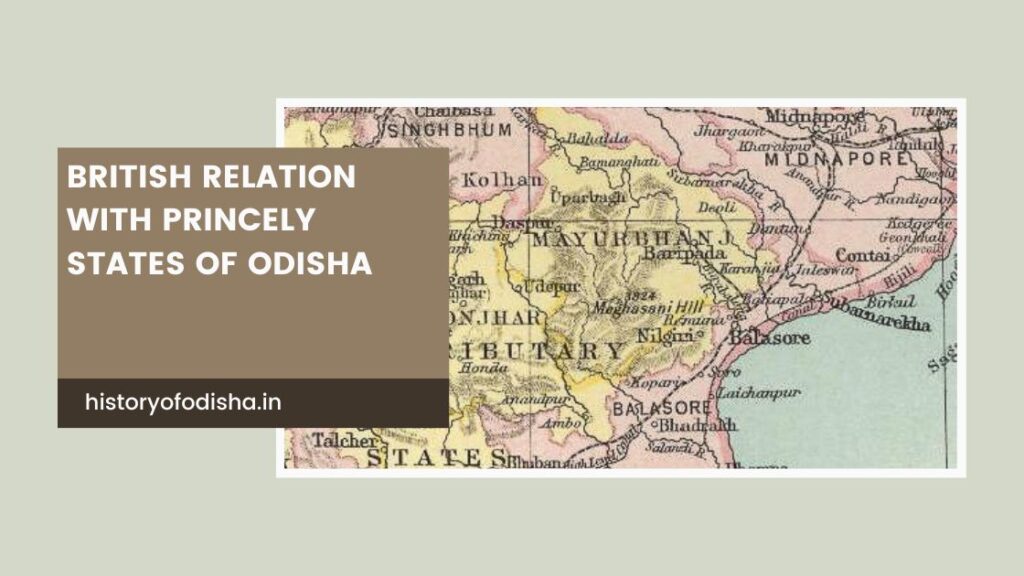
During British rule, Odisha was divided into two kinds of territory. British Odisha, consisting mainly of the coastal districts of Cuttack, Puri and Balasore (and later Sambalpur, Angul and others), was ruled directly by the British. The hilly and forested interior was divided into a large number of small kingdoms ruled by hereditary chiefs. These were known by several names: Feudatory States, Native States, Princely States, Garjat (Garhjat) States or Tributary Mahals. The word Garjat comes from garh (fort), meaning the land of forts.
The relationship between the British and these princely states changed greatly over about 140 years, from the British conquest of Odisha in 1803 to the merger of the states with the Odisha province in 1948–49. This article traces that relationship: from non-interference, through growing supervision, to the redefinition after 1857, the appointment of a Political Agent in the twentieth century, the challenge of the Prajamandal movements and finally the end of princely rule.
Read more: British Administration in Odisha
Key points at a glance
| Item | Details |
|---|---|
| Names | Feudatory States, Native States, Princely States, Garjat States, Tributary Mahals |
| Number at the time of merger | Twenty-six |
| First legal step | Regulation XII of 1805 (exempted the states from British laws) |
| Superintendent of the Tributary Mahals | Office created 1814; powers defined by Regulation XI of 1816; first Superintendent Edward Impey |
| States annexed | Banki (1840), Angul (1847–48) |
| Sanads | 1862 (hereditary title and right of adoption) |
| Durbar | Cuttack, November 1874 (Sir Richard Temple) |
| Political Agent | L. E. B. Cobden-Ramsay, 1906 |
| Popular movements | Prajamandal movements, mainly 1930s–1940s |
| Merger | 1 January 1948 (most states); Mayurbhanj 1 January 1949 |
Table of Contents
The Princely States of Odisha
By 1947–48, the princely states connected with Odisha numbered twenty-six. They can be grouped into three categories according to their history:
1. The original Garjat states of Odisha
These were the states attached to Odisha from the time of the British conquest. They included Angul, Athgarh, Athmallik, Banki, Baud (Boudh), Baramba, Daspalla, Dhenkanal, Hindol, Khandapara, Keonjhar, Mayurbhanj, Narasinghpur, Nayagarh, Nilgiri, Pal Lahara, Ranpur, Talcher and Tigiria.
Two of them, Banki and Angul, were later annexed by the British and became part of British Odisha, in 1840 and 1847–48 respectively.
2. States transferred from the Central Provinces (1905)
In 1905, five states that had been under the Central Provinces, namely Patna, Sonepur, Kalahandi, Bamra and Rairakhol, were transferred to the Odisha Division of Bengal, along with Sambalpur district. This was an important step in the movement to unite the Odia-speaking areas.
3. States transferred from Chota Nagpur (1905)
In the same year, two more states, Gangpur and Bonai, were transferred from Chota Nagpur to the Odisha Division. Seraikela and Kharsawan, two other states attached to Odisha in the twentieth century, were later merged with Bihar in 1948.
Nature of the states
The states varied greatly in size, wealth and population. Mayurbhanj was the largest and richest, with a progressive administration under rulers such as Maharaja Sriram Chandra Bhanj Deo. Others, such as Tigiria or Khandapara, were very small. Many states had large tribal populations, and their economies depended on agriculture, forests and, later, minerals.
Early British Policy towards the States (1803–1814)
When the British conquered Odisha from the Marathas in 1803, they made agreements with the chiefs of the Garjat states. The chiefs accepted British supremacy and agreed to pay a fixed annual tribute (peshkash), and in return they were left to rule their states. The main features of this early relationship were:
- Indirect control: unlike British Odisha, which was ruled directly by the British government, the feudatory states were controlled indirectly. The British were the supreme or sovereign (paramount) authority, and the states were its subordinate allies.
- Policy of non-interference: the British followed a policy of not interfering in the internal affairs of the states. Regulation XII of 1805 exempted the nineteen states from the administrative laws (regulations) of British-ruled Odisha. In these early years the British tried to win the goodwill and cooperation of the states.
- End of the hands-off policy: from about 1813 this hands-off (laissez-faire) approach began to change. The British now insisted on the loyalty of the chiefs and on the maintenance of law and order, and they began to interfere in internal affairs, as in the cases of Dhenkanal and Mayurbhanj.
Read more: The Paika Rebellion of 1817
The Superintendent of the Tributary Mahals
Creation of the office (1814–1816)
In 1814 the British created the office of Superintendent of the Tributary Mahals. Its powers were defined by Regulation XI of 1816:
- The chiefs were responsible for civil and criminal justice in their own states.
- They had to report serious crimes, and especially cases needing capital punishment, to the Superintendent.
- The Superintendent had the power to decide disputes over inheritance and succession and similar claims.
Edward Impey, the Judge-cum-Magistrate of Cuttack, was appointed the first Superintendent in 1814.
The new office brought the Garjat states under closer British supervision. This was done without hostility towards the chiefs or the people of the hill tracts, because the British policy was still one of non-interference in the states’ internal affairs.
Changes in the 1810s and 1820s
- According to the original account, in 1817 the post of Superintendent was transferred from the Judge-cum-Magistrate of Cuttack to the Commissioner of Odisha. (The Commissionership of Cuttack was fully organised in the following years, and from then on the Commissioner usually held the office of Superintendent.)
- In 1821 the government decided that it would intervene only in matters of a political nature, such as feuds between chiefs, defiance of or disloyalty to the government, and oppression by the chiefs.
Annexation of Banki and Angul
On political grounds, the chiefs of Banki and Angul were imprisoned and their states were annexed to British Odisha:
- Banki (1840): the Raja of Banki was convicted of a serious crime and the state was taken over.
- Angul (1847–48): Raja Somnath Singh of Angul was accused of helping the Kandha rebel Chakra Bisoi and of seizing a village of the neighbouring state of Hindol. Angul was annexed and the Raja was sent as a prisoner to Hazaribagh.
Read more: The Kandha Rising under Chakra Bisoi
The Impact of the Revolt of 1857
The Great Revolt of 1857 brought a clear change in British policy towards the princely states all over India. The British realised that loyal princes could be strong supporters of their rule.
- Most of the chiefs of Odisha remained loyal to the British during the revolt and helped them. This led the government to adopt a friendly and conciliatory policy towards them.
- In 1862 the Crown granted sanads (charters) to the chiefs, confirming their hereditary title of Raja and guaranteeing them the right of adoption. This removed the fear that their states might be annexed for lack of a natural heir, as had happened under Lord Dalhousie’s Doctrine of Lapse.
- For their services during 1857, the chiefs of Mayurbhanj and Keonjhar were given the title of Maharaja.
- At a grand Durbar held at Cuttack in November 1874, Sir Richard Temple, the Lieutenant Governor of Bengal, congratulated the chiefs.
At the same time the relationship was redefined. The British government reaffirmed its moral responsibility for good government in the states, including the right to intervene in cases of oppression, breakdown of law and order and disputed succession. The Keonjhar crises of 1868 and 1891, when the British sent troops and later took over the administration, show this policy in action.
Read more: The Bhuyan Rising under Ratna Naik
Consequences of the Relationship in the Nineteenth Century
The relationship between the British and the feudatory states had the following results:
- Increase in British power: the rulers became staunch supporters of the British Raj and competed for the favour of British officials. Under its right of supervision, the government could intervene in their administration whenever necessary.
- Careless and oppressive rule: the chiefs were often careless and, in some cases, oppressive. As long as they kept the approval of the paramount power, they could continue in spite of misrule.
- Popular discontent: misgovernment was widespread. Discontent grew among the peasants and tribal people, who formed the majority of the population. In the second half of the nineteenth century, disturbances and agrarian risings broke out in several states, including Baud, Athmallik, Keonjhar and Nayagarh.
Read more: The Bhuyan Rising under Dharanidhar Naik
The Twentieth Century: The Political Agent and the Feudatory States Manual
In the twentieth century, the growth of national consciousness worried the British authorities. They tried to build a closer relationship with the feudatory chiefs, while also wanting the princes to pay more attention to the welfare of their people. Two important steps were taken:
1. Appointment of a Political Agent
Sir Andrew Fraser, Lieutenant Governor of Bengal, strongly recommended the appointment of a Political Agent for the Feudatory States of Odisha, who would work under the Commissioner of Odisha. The Political Agent was to act as a friend, philosopher and guide to the rulers, so that the states would be well administered. L. E. B. Cobden-Ramsay was appointed the first Political Agent for the Feudatory States of Odisha in 1906.
In states that were directly managed by the British, for example during the minority of a ruler or after a breakdown of administration, the Political Agent acted as the chief authority, subject to the Commissioner’s control.
2. The Feudatory States Manual
The government compiled a Manual of the Feudatory States, based on the sanads granted to the chiefs. It served as a guide for the chiefs. It recognised their dignity and status as a valuable asset, while at the same time helping them to carry out their duties properly.
These measures had far-reaching effects. They kept the goodwill and loyalty of the chiefs, encouraged sound administration and, the British hoped, would help to keep nationalist movements out of the states.
The Eastern States Agency
In the 1930s the British reorganised the supervision of the princely states. The Odisha states were placed under the Eastern States Agency (formed in 1933), which dealt directly with the Government of India through a Resident, rather than through the provincial government.
The Prajamandal Movements
After 1920, and especially in the 1930s, many states faced serious challenges from the Prajamandals (people’s associations) and the Orissa States’ People’s Conference (founded 1931). These movements demanded:
- an end to forced labour (bethi), illegal taxes and the rulers’ monopolies;
- rights over forests and land;
- civil liberties; and
- responsible and representative government in the states.
Their cause was supported by the Indian National Congress, and leaders such as Harekrushna Mahtab, Nabakrushna Choudhury and Sarangadhar Das played an important part. Major movements took place in Dhenkanal, Talcher, Nilgiri and Ranpur in 1938–39. In Dhenkanal the boy Baji Rout was shot dead by the police in October 1938, and in Ranpur the Political Agent, Major R. L. Bazalgette, was killed by a crowd in January 1939.
The British Recognise the Changing Situation
The British government too became aware of the changing situation. The Montagu–Chelmsford Report (1918) had already noted misrule, popular discontent and the growth of political consciousness in the states, which the princes could not ignore. The British realised that the feudatory chiefs, who had been a pillar of strength for them, would not survive unless they gave good government. This view was expressed in the statements of the Viceroy, Lord Linlithgow, in 1939 and of the Secretary of State for India, L. S. Amery, in 1943, who urged the princes to introduce reforms and, in the case of very small states, to consider joining together.
The End of Princely Rule: The Merger of 1948–49
With independence in 1947, British paramountcy over the states came to an end. Under pressure from the Prajamandal movements and the new Government of India, and with the strong efforts of Sardar Vallabhbhai Patel, V. P. Menon and Harekrushna Mahtab, the Premier of Odisha, the rulers agreed to merge their states.
- On 14–15 December 1947, most of the rulers met Sardar Patel at Cuttack and signed merger agreements.
- The states merged with Odisha on 1 January 1948.
- Seraikela and Kharsawan were transferred to Bihar in 1948.
- Mayurbhanj merged with Odisha on 1 January 1949.
The merger nearly doubled the area of Odisha and brought the people of the former states into a single democratic state.
Assessment
During the two decades before the merger of 1948, some states introduced reforms and made progress in administration, education and public works; Mayurbhanj, for example, was known for its relatively progressive administration. In other states, however, oppression and the suppression of popular movements continued. In the last years of their rule, the British saw the writing on the wall: they knew that the days of the chiefs were numbered, and their support for the chiefs became lukewarm.
Phases of British policy at a glance
| Phase | Period | Main features |
|---|---|---|
| Non-interference | 1803–1813 | Agreements with chiefs; tribute; Regulation XII of 1805 |
| Supervision | 1814–1857 | Superintendent of the Tributary Mahals (1814, Regulation XI of 1816); intervention in political matters (1821); annexation of Banki and Angul |
| Partnership and responsibility | 1858–1905 | Sanads of 1862; titles; Durbar of 1874; intervention for good government |
| Guidance and control | 1906–1930s | Political Agent (1906); Feudatory States Manual; Eastern States Agency |
| Decline and merger | 1930s–1949 | Prajamandal movements; British pressure for reform; merger with Odisha |
Timeline
| Date | Event |
|---|---|
| 1803 | British conquest of Odisha; agreements with the Garjat chiefs |
| 1805 | Regulation XII exempts the states from British regulations |
| 1813 | Beginning of closer British interference |
| 1814 | Office of Superintendent of the Tributary Mahals created; Edward Impey appointed |
| 1816 | Regulation XI defines the Superintendent’s powers |
| 1817 | Commissioner made Superintendent (as per original account) |
| 1821 | Intervention limited to political matters |
| 1840 | Banki annexed |
| 1847–48 | Angul annexed |
| 1857 | Revolt; most Odisha chiefs remain loyal |
| 1862 | Sanads granted (hereditary title; right of adoption) |
| November 1874 | Durbar at Cuttack under Sir Richard Temple |
| 1905 | Five Central Provinces states and Gangpur and Bonai joined to the Odisha Division |
| 1906 | L. E. B. Cobden-Ramsay appointed Political Agent |
| 1918 | Montagu–Chelmsford Report |
| 1931 | Orissa States’ People’s Conference founded |
| 1933 | Eastern States Agency formed |
| 1938–39 | Prajamandal movements in Dhenkanal, Talcher, Nilgiri, Ranpur |
| 1939 and 1943 | Statements of Lord Linlithgow and L. S. Amery |
| 14–15 December 1947 | Merger agreements signed at Cuttack |
| 1 January 1948 | States merge with Odisha |
| 1 January 1949 | Mayurbhanj merges with Odisha |
Sources for the Study of the Subject
- Regulations and sanads: Regulation XII of 1805, Regulation XI of 1816 and the sanads of 1862.
- Gazetteers: L. E. B. Cobden-Ramsay, Feudatory States of Orissa (Bengal Gazetteers, 1910), and later district gazetteers.
- Administrative reports of the Political Agent and the Commissioner of Odisha, in the Odisha State Archives.
- Records of the Prajamandal movements and of the Orissa States’ People’s Conference, including the report of the States Enquiry Committee (1939).
- V. P. Menon’s The Story of the Integration of the Indian States (1956), for the merger.
Points of Debate
- Protection or control? British policy is sometimes described as protecting the states, but in practice the British increasingly controlled them. Historians debate how much real independence the chiefs had.
- Benefits of the relationship: British support kept the chiefs in power and gave them stability, but it also allowed many of them to rule badly without fear of their people.
- The date of Angul’s annexation is given as 1847 in some accounts and 1848 in others.
- The role of the people: the merger is often credited to Patel, Menon and Mahtab, but the Prajamandal movements and popular pressure made it possible.
Recent Developments
- The merger of the princely states is commemorated in Odisha, and the integration of 1948 is regularly discussed in studies of how Odisha took its present shape.
- Many former palaces of the Garjat rulers, such as those at Dhenkanal and Mayurbhanj (Belgadia Palace), have become heritage sites or homestays and are part of Odisha’s heritage tourism.
- The memory of the Prajamandal martyrs, especially Baji Rout, the youngest martyr of India’s freedom struggle, is honoured every year.
- The topic is part of the OPSC syllabus and of university courses on modern Odisha.
Conclusion
The relationship between the British and the princely states of Odisha passed through several phases. It began with indirect control and non-interference under Regulation XII of 1805, moved to closer supervision through the Superintendent of the Tributary Mahals from 1814, and led to the annexation of Banki and Angul. After 1857 the British turned the chiefs into loyal allies through the sanads of 1862, titles and durbars, while claiming a moral responsibility for good government. In the twentieth century the Political Agent and the Feudatory States Manual brought the states under closer guidance, partly to keep out nationalism. Yet misrule and oppression in many states produced popular risings in the nineteenth century and the Prajamandal movements of the 1930s. By the 1940s the British themselves recognised that the princes’ days were numbered. With independence and the merger of 1948–49, princely rule in Odisha came to an end, and the people of the Garjat states became citizens of a united, democratic Odisha.
Quick Revision for OPSC and University Exams
- Names: Feudatory / Native / Princely / Garjat States; Tributary Mahals; 26 states by 1947–48.
- Three groups: original Garjats (19, incl. Angul and Banki); five Central Provinces states (Patna, Sonepur, Kalahandi, Bamra, Rairakhol) transferred 1905; Gangpur and Bonai from Chota Nagpur (1905).
- Regulation XII of 1805: states exempted from British regulations.
- 1814: Superintendent of Tributary Mahals; Regulation XI of 1816; first Superintendent Edward Impey.
- 1821: intervention only in political matters.
- Annexations: Banki (1840), Angul (1847–48).
- 1862 sanads: hereditary title; right of adoption; Mayurbhanj and Keonjhar chiefs made Maharaja.
- Cuttack Durbar, November 1874: Sir Richard Temple.
- Political Agent: L. E. B. Cobden-Ramsay, 1906 (on Sir Andrew Fraser’s recommendation); Feudatory States Manual.
- Eastern States Agency: 1933.
- Prajamandals: Orissa States’ People’s Conference (1931); Dhenkanal (Baji Rout), Ranpur (Bazalgette killed, 1939).
- Merger: agreements 14–15 Dec 1947; merged 1 Jan 1948; Mayurbhanj 1 Jan 1949.
Practice Questions
Short answer (about 50–75 words)
- What were the Garjat states?
- What was the significance of Regulation XII of 1805?
- What were the powers of the Superintendent of the Tributary Mahals?
- What were the sanads of 1862?
- Why was a Political Agent appointed for the Feudatory States of Odisha in 1906?
Long answer (about 250–400 words)
- Trace the evolution of British relations with the princely states of Odisha from 1803 to 1947.
- Discuss the impact of the Revolt of 1857 on British policy towards the feudatory states of Odisha.
- Examine the causes and results of the Prajamandal movements in the princely states of Odisha.
Multiple choice questions
- The office of Superintendent of the Tributary Mahals was created in: (a) 1803 (b) 1814 (c) 1857 (d) 1906
- The first Superintendent of the Tributary Mahals was: (a) Richard Temple (b) Edward Impey (c) T. E. Ravenshaw (d) Andrew Fraser
- Which of these states was annexed by the British in 1840? (a) Angul (b) Banki (c) Talcher (d) Hindol
- The first Political Agent for the Feudatory States of Odisha was: (a) L. E. B. Cobden-Ramsay (b) R. L. Bazalgette (c) G. Toynbee (d) H. P. Wylly
- Which state merged with Odisha on 1 January 1949? (a) Keonjhar (b) Dhenkanal (c) Mayurbhanj (d) Kalahandi
Frequently Asked Questions
What does “Garjat” mean? It comes from garh (fort) and refers to the hill states of Odisha, each centred on the fort of its ruler.
Why did the British stop annexing states after 1857? Most princes had stayed loyal during the revolt, so the British decided to keep them as allies, guaranteeing their titles and their right to adopt heirs.
What were the Prajamandals? They were people’s associations in the princely states that demanded an end to forced labour and illegal taxes and the introduction of responsible government.
Further Reading on This Site
- British Administration in Odisha
- The Kandha Rising under Chakra Bisoi
- The Bhuyan Rising under Ratna Naik
- The Bhuyan Rising under Dharanidhar Naik
- The Quit India Movement in Odisha
References
- Das, Manas Kumar. History of Odisha, Vol. III.
- Sahu, N. K., Sahu, P. K., and Mishra, J. K. History of Orissa.
- Cobden-Ramsay, L. E. B. Feudatory States of Orissa (Bengal Gazetteers). Calcutta, 1910.
- Menon, V. P. The Story of the Integration of the Indian States. Bombay, 1956.
- Patra, K. M. Orissa Legislature and Freedom Struggle. New Delhi, 1979.
- Pati, Biswamoy. Resisting Domination: Peasants, Tribals and the National Movement in Orissa, 1920–50. New Delhi, 1993.
© History of Odisha · Generated on November 29, 2026